
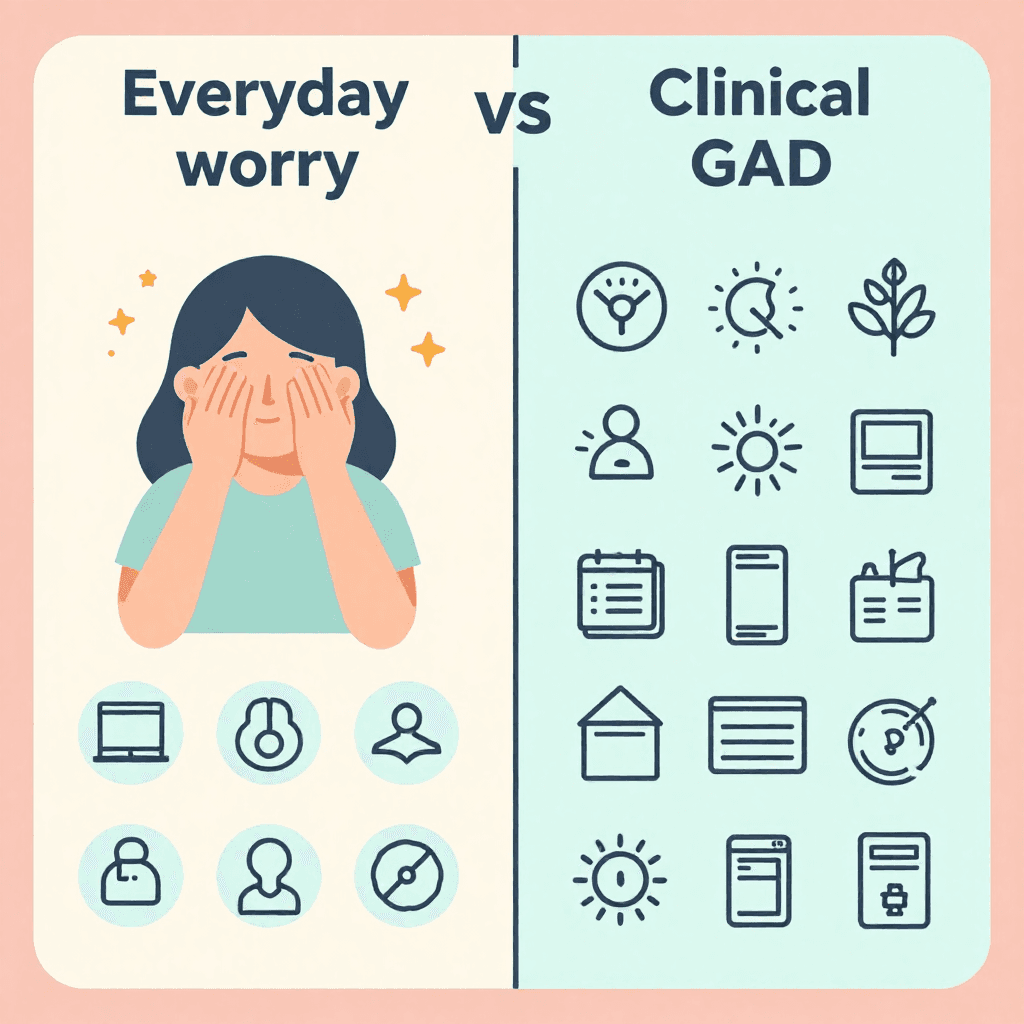
What separates everyday worry from clinical GAD — and what treatment actually looks like
Understanding Generalized Anxiety Disorder: A Compassionate Guide to Finding Peace
Does your mind feel like a browser with too many tabs openeach one running worst-case scenarios on repeat? Do you find yourself worrying about everything from your health to your job performance to whether you remembered to lock the door, even when there's no immediate threat? If this sounds familiar, you're not alone. Generalized Anxiety Disorder (GAD) affects millions of Americans, and understanding it is the first step toward discovering your true self beneath the weight of constant worry.
At Genesis Therapeutics, we've walked alongside countless individuals in Connecticut who thought their anxiety was just "who they are." But here's the hopeful truth: GAD is a treatable condition, not a personality flaw. With compassionate care and the right support, you can reclaim the peace that anxiety has stolen from your daily life.
What Is Generalized Anxiety Disorder?
Generalized Anxiety Disorder is characterized by persistent, excessive worry about various aspects of daily lifework, health, family, financesthat's difficult to control and occurs more days than not for at least six months. Unlike the normal anxiety we all experience before a big presentation or important event, GAD doesn't need a specific trigger. The anxiety itself becomes the constant companion you never asked for.
People with GAD often describe feeling like they're waiting for the other shoe to drop, even on good days. You might find yourself:
Anticipating disaster in situations that don't warrant such concern
Overthinking plans and solutions to every possible negative outcome
Perceiving situations and events as threatening, even when they're not
Struggling with indecisiveness and fear of making the "wrong" choice
Finding it nearly impossible to relax or "turn off" your worried thoughts
What makes GAD particularly exhausting is its all-encompassing nature. While someone with a specific phobia might only experience anxiety in certain situations, GAD casts a wider net, touching multiple areas of life simultaneously.
The Physical Experience: When Your Body Responds to Your Mind
Anxiety isn't just "all in your head"it's a full-body experience. Your brain and body are intimately connected, and when your mind perceives threat (even imagined ones), your body responds as if the danger is real. This is why understanding the physical symptoms of GAD is so important.
Common physical manifestations include:
Muscle tension and pain: Particularly in the neck, shoulders, and jaw from chronic clenching
Fatigue: Constant worry is mentally exhausting, leaving you drained even after a full night's sleep
Sleep disturbances: Difficulty falling asleep, staying asleep, or experiencing restful sleep
Digestive issues: Stomach aches, nausea, diarrhea, or irritable bowel symptoms
Headaches: Tension headaches that seem to appear without clear cause
Restlessness: Feeling keyed up, on edge, or unable to sit still
Difficulty concentrating: Your mind going blank or struggling to focus on tasks
These physical symptoms aren't separate from your anxietythey're part of how GAD expresses itself through your body. Recognizing this connection helps validate your experience and reinforces that what you're feeling is real and treatable.
Who Does GAD Affect and Why?
Generalized Anxiety Disorder doesn't discriminate, but certain factors can increase vulnerability. Women are diagnosed with GAD at twice the rate of men, though this may partly reflect differences in help-seeking behavior rather than actual prevalence. GAD can develop at any age, though it often begins in childhood or adolescence and can persist into adulthood if left untreated.
Several factors contribute to GAD development:
Biological factors: Differences in brain chemistry, particularly involving neurotransmitters like serotonin, GABA, and norepinephrine, play a significant role. There's also a genetic componenthaving family members with anxiety disorders increases your risk.
Environmental influences: Childhood experiences, including trauma, abuse, or even having overly anxious parents who modeled worried thinking, can shape how your brain processes threat and safety. Chronic stress, major life changes, or traumatic events can trigger or worsen GAD.
Personality traits: Certain temperamental characteristics, such as behavioral inhibition (being naturally more cautious or shy) or having a tendency toward negative thinking patterns, can increase susceptibility.
Understanding these risk factors isn't about assigning blameit's about recognizing that GAD has complex roots. This knowledge can actually be reassuring: you didn't choose this, and with the right support, you can address it from multiple angles.
The Path Forward: Evidence-Based Treatment Approaches
Here's where hope enters the picture: GAD is one of the most treatable anxiety disorders. At Genesis Therapeutics, we believe in the "minimum effective dose" approachfinding the right combination of treatments that provides maximum benefit with the least interference in your life.
Psychotherapy: Cognitive Behavioral Therapy (CBT) has the strongest evidence base for treating GAD. CBT helps you identify worry patterns, challenge anxious thoughts, and develop healthier ways of relating to uncertainty. Many people find that understanding how their thoughts influence their emotions creates a powerful shift in how they experience daily life.
Medication management: For some individuals, medication can be an important part of treatment. As a board-certified psychiatric nurse practitioner, I work collaboratively with patients to determine if medication might be helpful. Options include SSRIs, SNRIs, or other medications depending on your unique situation. The goal is always to find the minimum effective dose that helps restore your quality of life.
Lifestyle interventions: While not standalone treatments, regular exercise, adequate sleep, limiting caffeine and alcohol, and practicing stress-reduction techniques like mindfulness or progressive muscle relaxation can significantly support your recovery. These aren't just "wellness tips"they're evidence-based components of comprehensive anxiety treatment.
Addressing co-occurring conditions: GAD often doesn't travel alone. Depression, other anxiety disorders, or substance use issues may be present. Comprehensive treatment addresses all aspects of your mental health, not just isolated symptoms.
Living Well with GAD: Practical Strategies for Daily Life
Recovery isn't about never feeling anxious againit's about changing your relationship with anxiety and building resilience. Here are practical strategies that complement professional treatment:
Create a "worry window": Designate 15-20 minutes daily for focused worry time. When anxious thoughts arise outside this window, acknowledge them and gently redirect: "I'll think about this during my worry time." This helps contain anxiety rather than letting it dominate your entire day.
Practice grounding techniques: When anxiety spirals, use the 5-4-3-2-1 technique: Name 5 things you see, 4 you can touch, 3 you hear, 2 you smell, and 1 you taste. This anchors you in the present moment rather than anxious futures that may never materialize.
Challenge your thoughts gently: When you notice catastrophic thinking, ask yourself: "What's the evidence for this thought? What would I tell a friend in this situation? What's a more balanced way to look at this?" You're not dismissing your feelingsyou're creating space for alternative perspectives.
Build your support network: Isolation intensifies anxiety. Whether it's trusted friends, family, support groups, or professional care, connection reminds us we're not alone in our struggles.
Celebrate small victories: Recovery isn't linear. Notice and acknowledge moments when you chose differentlywhen you challenged a worry
Ready to Start Your Journey?
Evidence-based psychiatric care, wherever you are. Book a same-week telehealth appointment.